
Standard Zoom : DSLR Canon EF-S 17-55mm f/2.8 IS USM
Standard Zoom : DSLR Canon EF-S 17-55mm f/2.8 IS USM
The Canon EF-S 17-55mm f/2.8 IS USM Lens, with a fast, fixed f/2.8 aperture, very high image quality, 3-stop Image Stabilization and a very popular focal length range, is one of the best general/multi-purpose lenses available.
Since EF-S lenses only mount on Canon EF-S bodies - which all feature a 1.6x FOVCF - the 17-55mm focal length range always equates to the field of view of a 27.2-88mm lens mounted on a full-frame Digital SLR. This range covers what I consider to be the most important focal lengths for a Canon general purpose lens. This is a focal length range that can be used for everything from a wide scenic landscape to a relatively-close portrait.
Canon already had these focal lengths similarly covered in their econo kit lens - the Canon EF-S 18-55mm f/3.5-5.6 Lens. Reality is that these are vastly different lenses - in build, optical and feature qualities - and price. The kit lens is a good value for the money, but does not compare with the Canon EF-S 17-55mm f/2.8 IS USM Lens.
Canon already had a superset of the 17-55mm focal length range covered with the Canon EF-S 17-85mm f/4-5.6 IS USM Lens. This lens has a higher build quality, image quality and feature set than the EF-S 18-55 - adding Ring USM and 3 stop image stabilization to the feature set. What the Canon EF-S 17-55mm f/2.8 IS USM Lens adds to the 17-85's feature set is a fixed f/2.8 aperture and L-Series grade UD (Ultra-Low Dispersion glass) lens elements. Of course, price, size, weight and a reduced focal length range are the downsides of the 17-55 compared to the 17-85.
Reference: http://www.the-digital-picture.com
Standard Zoom : DSLR Canon EF-S 17-55mm f/2.8 IS USM
Standard Zoom : DSLR Canon EF-S 17-55mm f/2.8 IS USM
Canon’s EF-S 17-55mm f/2.8 IS USM is a premium zoom lens designed for EF-S bodies and announced alongside the EOS-30D digital SLR in February 2006. Boasting a constant f2.8 aperture throughout the range, it’s the fastest standard focal length zoom lens available for Canon EF-S mount digital SLRs. The lens also features Image Stabilisation to help combat camera-shake.
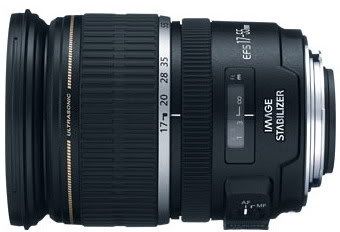
Featuring a USM focusing motor and Image Stabilisation, the EF-S 17-55mm clearly goes up against Canon’s existing EF-S 17-85mm f/4-5.6 IS USM, and while the latter features a longer range and cheaper price, the new model boasts a much faster aperture, allowing very shallow depths-of-fields and improved low-light performance.
The optical design consists of 19 elements in 12 groups with two Ultra-Low Dispersion glass (UD) elements to eliminate secondary chromatic aberrations, along with two aspherical elements to avoid spherical aberrations at wider apertures.
In this in-depth review of the EF-S 17-55mm we’ll test its low-light capabilities and compare its performance against the EF-S 17-85mm, along with the budget EF-S 18-55mm model. To see how Canon’s premium L glass compares, we’ve also included lab results from Canon’s EF 17-40mm f/4.0L lens, which has the additional benefit of being compatible with full-frame bodies should you wish to upgrade in the future. All four lenses were tested using a Canon EOS 400D / Digital Rebel XTi.
Reference: http://www.cameralabs.com/
Canon EF LENS Specifications
Super cool today I would like to know What Canon EF LENS Specifications is? I got all this DSLR Canon Lens. There are so many type of Canon EF Lens Specifications.
Which is
1. Ultra-Wide Zoom
2. Standard Zoom
3. Telephoto Zoom
4. Wide-Angle
5. Standard & MediumTelephoto
6. Telephoto
7. Super Telephoto
8. Macro
9. Tilt-Shift
10. Extenders
Canon EF LENS Specifications
Ultra-Wide Zoom
EF-S 10-22mm f/3.5-4.5 USM
EF 16-35mm f/2.8L II USM
EF 16-35mm f/2.8L USM
EF 17-35mm f/2.8L USM
EF 17-40mm f/4L USM
EF 20-35mm f/2.8 USM
EF 20-35mm f/3.5-4.5 USM
Standard Zoom
EF-S 17-55mm f/2.8 IS USM
EF-S 17-85mm f/4-5.6 IS USM
EF-S 18-55mm f/3.5-5.6 IS
EF-S 18-55mm f/3.5-5.6 USM
EF-S 18-55mm f/3.5-5.6
EF 22-55mm f/4-5.6 USM
EF 24-70mm f/2.8L USM
EF 24-85mm f/3.5-4.5 USM
EF 24-105mm f/4L IS USM
EF 28-70mm f/2.8 L USM
EF 28-70mm f/3.5-4.5
EF28-80mmf/3.5-5.6IVUSM†/VUSM
EF 28-80mm f/3.5-5.6 III / II
EF 28-80mm f/3.5-5.6
EF 28-90mm f/4-5.6 III / II USM
EF28-105mmf/3.5-4.5IIUSM/USM
EF 28-105mm f/4-5.6 USM
EF 28-135mm f/3.5-5.6 IS USM
EF 28-200mm f/3.5-5.6 USM
EF 35-80mmf/4-5.6 III / II / USM
EF 35-135mm f/4-5.6 USM
EF 28-90mm f/4-5.6 USM
Telephoto Zoom
EF 28-300mm f/3.5-5.6L IS USM
EF 35-350mm f/3.5-5.6L USM
EF55-200mmf/4.5-5.6IIUSM /USM
EF-S55-250mmf/4-5.6IS
EF 70-200mm f/2.8L IS USM/ USM
EF 70-200mm f/4L IS USM
EF 70-200mm f/4L USM
EF 70-300mm f/4.5-5.6 DO IS USM
EF 70-300mm f/4–5.6 IS USM
EF 75-300mm f/4–5.6 IS USM
EF75-300mmf/4-5.6IIIUSM/III/IIUSM
EF 75-300mm f/4-5.6 USM
EF 80-200mm f/2.8L
EF 80-200mm f/4.5-5.6 II / USM
EF 100-300mm f/4.5-5.6 USM
EF 100-300mm f/5.6 L
EF 100-400mm f/4.5-5.6L IS USM
Wide-Angle
EF 14mm f/2.8L II USM
EF 14mm f/2.8L USM
EF 15mm f/2.8 Fisheye
EF 20mm f/2.8 USM
EF 24mm f/1.4L USM
EF 24mm f/2.8
EF 28mm f/1.8 USM
EF 28mm f/2.8
EF 35mm f/1.4L USM
EF 35mm f/2
Standard & MediumTelephoto
EF 50mm f/1.0L USM
EF 50mm f/1.2L USM
EF 50mm f/1.4 USM
EF 50mm f/1.8 II
EF 50mm f/1.8
EF 85mm f/1.2L II USM / USM
EF 85mm f/1.8 USM
EF 100mm f/2 USM
Telephoto
EF 135mm f/2L USM
EF 135mm f/2.8 w/ Softfocus
EF 200mm f/1.8L USM
EF 200mm f/2L IS USM
EF 200mm f/2.8L II USM / USM
EF 300mm f/2.8L IS USM / USM
EF 300mm f/4L IS USM / USM
Super Telephoto
EF400mmf/2.8LISUSM/IIUSM/USM
EF 400mm f/4 DO IS USM
EF 400mm f/5.6L USM
EF 500mm f/4L IS USM
EF 500mm f/4.5L USM
EF 600mm f/4L IS USM / USM
EF 800mm f/5.6L IS USM
EF 1200mm f/5.6L USM
Macro
EF 50mm f/2.5 Compact Macro
EF-S 60mm f/2.8 Macro USM
MP-E 65mmf/2.8 1-5xMacro Photo
EF 100mmf/2.8Macro /Macro USM
EF 180mm f/3.5L Macro USM
Life Size Converter EF
Tilt-Shift
TS-E 24mm f/3.5L
TS-E 45mm f/2.8
TS-E 90mm f/2.8
Extenders
Extender EF 1.4x II
Extender EF 2x II
Next time I will show you what is each Canon EF Lens look like. I love DSLR CANON Products.
Red-Eye in Flash Photos
Hello Do you have a problem when you are taking a photo and you got a red spot on your eyes? This will tell you why this happen and will show you how to reduce the red spot when you take a photo with DSLR Canon Camera.
Red-Eye in Flash Photos
What is red-eye, and why does it happen?
We’ve all seen it in snapshots we’ve either taken ourselves, or been shown by others: the pupils of your subject’s eyes are lit up in a devilish bright red color, unlike anything we’re used to seeing in real life. And of course, you never saw it in your camera’s viewfinder when you took the picture.
What is happening is that the pupil of a person’s eye, even though it appears to be black when we view it, is actually clear. Since the inside of the eyeball is normally never illuminated, we see it as a small black circle. But in some flash photos, if the flash is close to the lens of the camera, its illumination sends a burst of light right through to the rear of the inside of the subject’s eyeball. The retina of your subject’s eyes is rich in red blood vessels, and this produces the bright red color we see in the pictures.
Red-eye is an unwanted effect of some flash photography, caused by flash light illuminating our retinas.
If the flash is close enough to the lens, the light not only enters your subject’s inner eye, but can then reflect straight back out and actually be recorded by the camera. With the retina in your subject’s eye now fully illuminated, you get the tell-tale bright red glow that we all now know as "red-eye." So the first thing to know is that for all intents and purposes, red-eye in photos is a flash phenomenon. It’s very unlikely you’ll encounter it using sunlight, or available light only when shooting indoors.
Using the built-in flash:
Cameras like the Canon EOS 30D, 40D, Rebel XSi and XTi have a built-in flash, that pops upwards a few inches for easy and convenient flash photography – at least, as long as your subjects are not too far away. And nearly every compact digital camera has a built-in flash as well. Since many of these cameras are so small in size, the designers are often forced to put the built-in flash nearly right next to the lens. Any time you use a built-in flash that’s close to the lens, you run the risk of occasionally getting red-eye in any pictures with people in the scene.
Obviously, you can’t physically move the built-in flash away from the camera lens (well, you could, but you wouldn’t be able to take pictures with it any more!). So manufacturers have resorted to another feature: Red-Eye Reduction.
Red-eye Reduction:
The idea of this feature is that by one means or another, the camera sends out light to your subject before the picture is taken. Since the subject’s pupils normally tend to dilate, or get wider, in dim light (and get smaller in bright light conditions), the idea is to reduce the level of red-eye by making the user’s pupils appear smaller before the picture is taken. With smaller pupils, there’s less area to be marred by red-eye, and even if it does show up in your pictures, it’ll tend to be less noticeable.
Some cameras do this by rapidly flashing the flash unit with "pulses" of flash illumination, for a second or two before the picture is taken. The hope is that your subject’s eyes will react to these rapid pops of light and the pupils will become smaller. A moment later, that actual picture is taken, with the flash firing again, but at (usually) greater power.
Canon’s cameras take a different approach, using a small, built-in lamp to shine continous white light directly at your subject for about two seconds, prior to the picture being taken. In fact, a scale appears on EOS digital SLRs with this feature in the viewfinder, to count down the two seconds that this red-eye reduction lamp is active, so that you know when to fully press the shutter button and take the picture. Again, the idea is that this added light before the picture is taken will cause the subject’s pupils to contract, and therefore reduce the level of red-eye if it appears.
It’s important to understand that neither of these approaches to in-camera red-eye control claims to completely eliminate the chance of getting visible red-eye. As the feature’s name says, it’s red-eye reduction, not red-eye elimination.
Reference : http://www.usa.canon.com

